What zisha is
Zisha is a family of iron-bearing pottery clays from the Dingshu area of Yixing, Jiangsu. After firing it ranges from purple-brown and red-brown to chestnut. It is not a single material from one mine, but a body blended from several clays and mineral components. Names such as zini, zhuni and duanni refer to colour, particle composition and fired result rather than three fixed recipes.
Most zisha ware is left unglazed. The body meets the tea directly, and the surface shows granules, flecks of mica and slight irregularities. Laboratory analysis of Yixing material identifies kaolinite, quartz, mica and hematite. Firing is around 1100–1170°C, and the studied samples average roughly 8–13% porosity, increasing from the outer surface toward the interior. That helps explain why the body is strong yet still feels absorbent and breathable.
From Yixing to the literati table
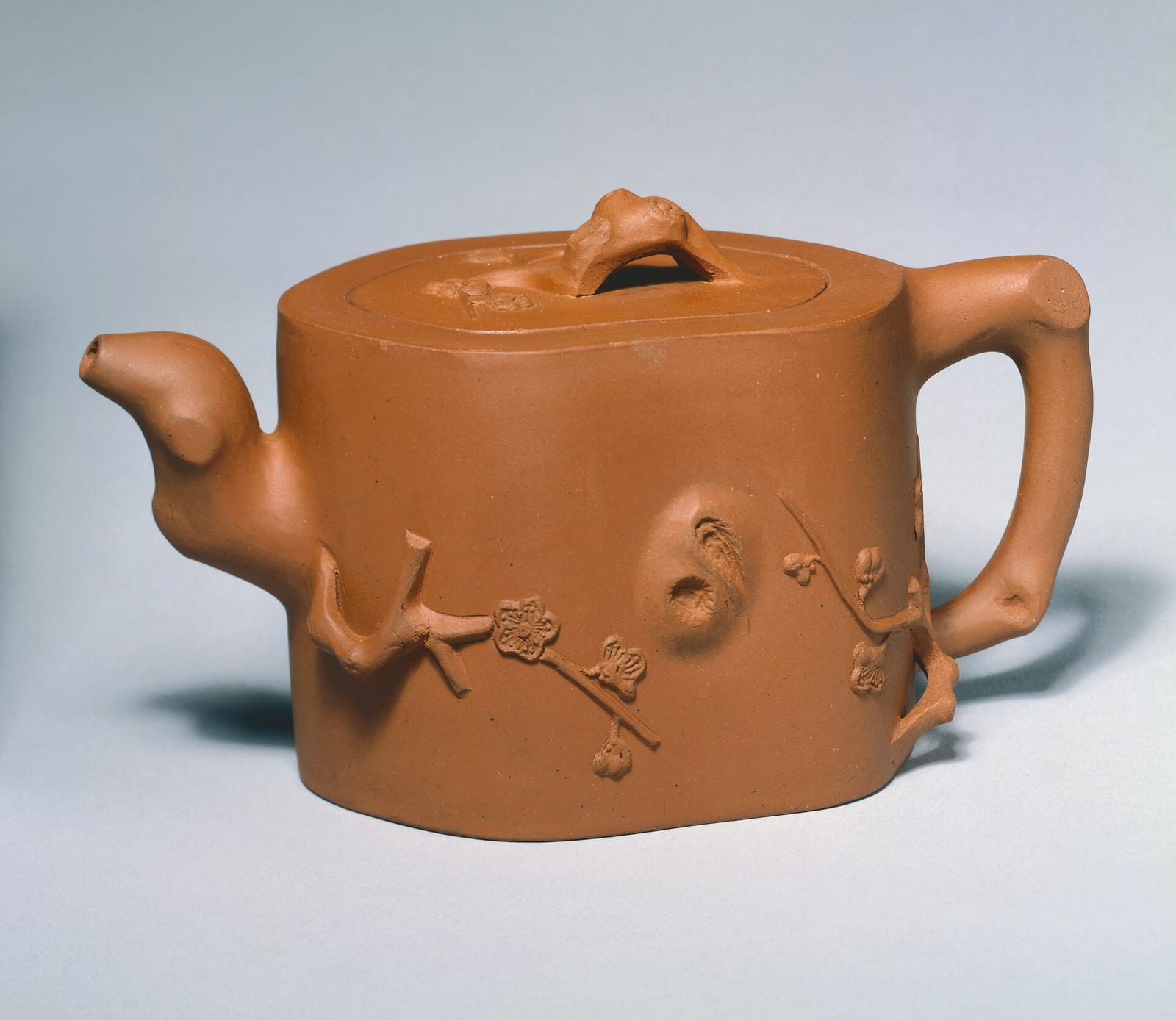
Yixing has a long ceramic history, but the zisha teapot became prominent on literati tea tables from the mid-Ming dynasty onward. Unlike glazed porcelain, it does not rely on glaze colour or painted decoration. It is judged by clay colour, form, line and touch. Names such as Gong Chun and Shi Dabin have been repeated for centuries, but confirmed early pieces are limited; legend should not be turned into a precise chronology.
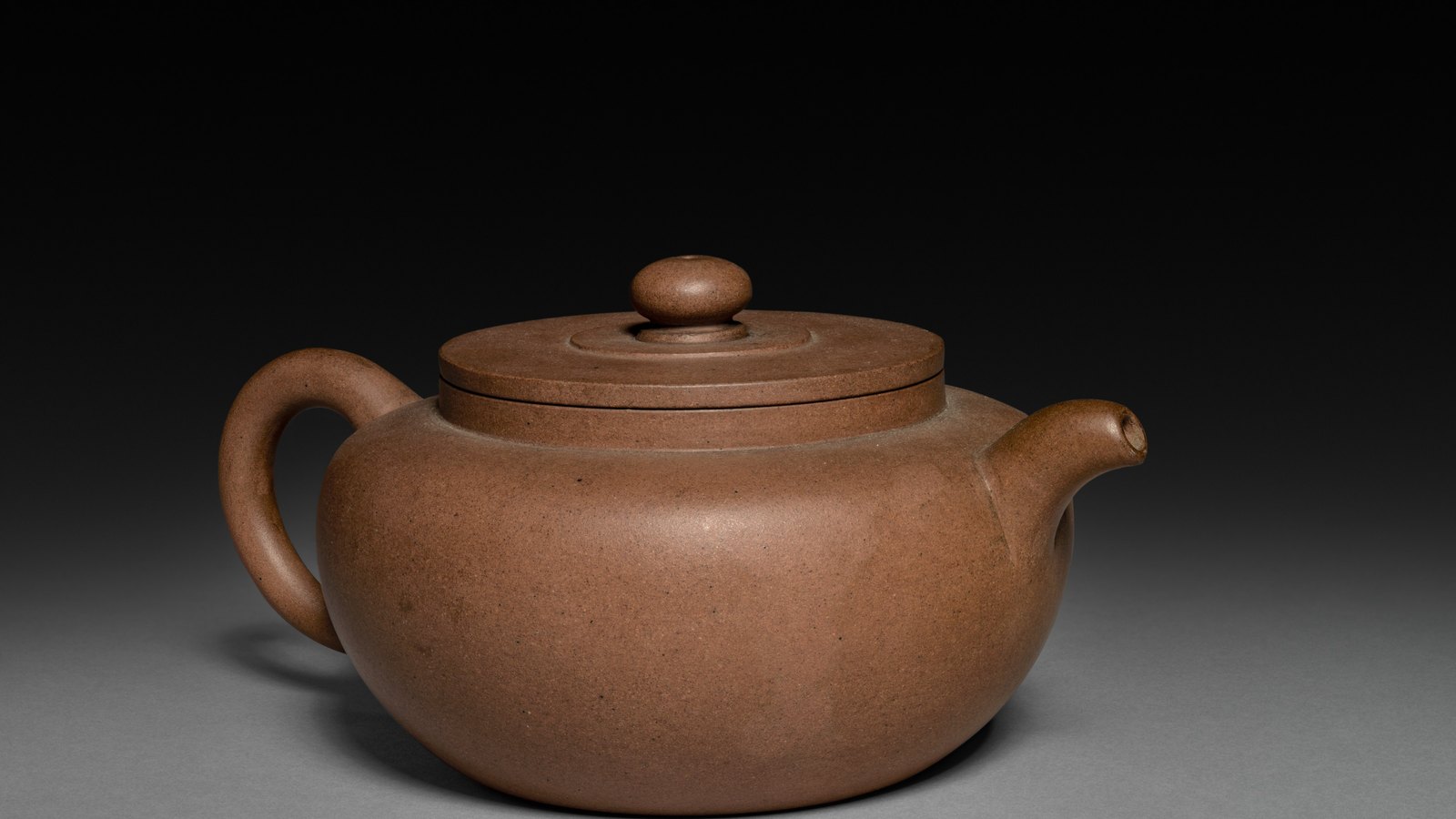
The Cleveland Museum of Art's teapot (1955.299) is a Qing dynasty piece, about 12.8 cm across and 8.6 cm high. It is plain and unglazed, with a full body and a short, straight spout. There is no decoration to distract from proportion, pouring, lid fit and the texture of the clay. That is what separates a zisha teapot from a decorative porcelain vessel.
Pores, aroma and one pot one tea
Fine pores in the fired body absorb some aromatic and taste compounds from tea. With long use, a dark tea stain builds up inside the pot and the surface becomes smoother to the touch. This is commonly called "raising" or "feeding" the pot. It does happen, but the extent depends on the clay, firing temperature, tea type and frequency of use. Not every zisha pot will retain aroma strongly.
"One pot, one tea" is a working rule, not a law. Keeping one pot for one tea reduces the chance that one aroma masks another and makes changes in the pot easier to observe. If you change tea, thorough washing and full drying usually reduce the carry-over. Treating the rule as an inflexible ritual can distract from cleaning, and wet leaf left in the pot is worse for the ware than a change of tea.
Choosing and caring for one
Start with use. A pot of 100–150 ml is usually enough for one drinker; around 200 ml is easier for two or three. Pouring should be smooth and stop cleanly, the lid should seat well, and the handle should not become uncomfortable when the pot is full. Clay name and maker reputation can come later; shape and spout are what you meet every day.
Rinse a new pot with warm water. There is no need to boil it with rice water, sugar or tea. After use, empty the leaf, rinse the interior, and leave the pot open in moving air until fully dry. Do not use detergent, and do not close a damp lid into a cupboard. Tea stains and signs of use are normal ageing, not defects that must be polished away. It is more useful as a clean working teapot than as an object kept on a shelf.