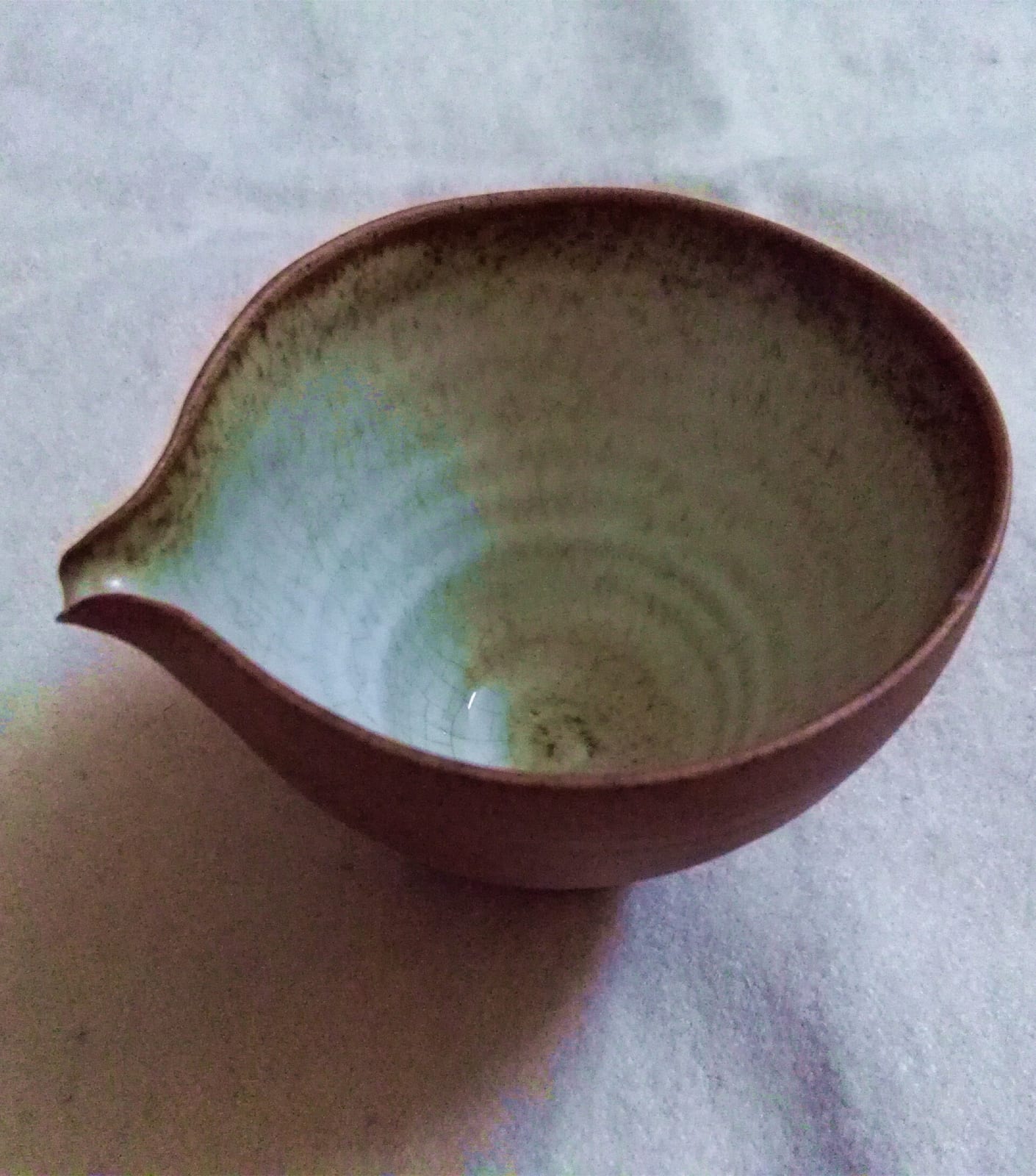
Why use one
If tea is poured directly from a pot or gaiwan into individual cups, the first cup is usually weaker or stronger than the last. A pitcher mixes the liquor before serving, so each cup is more even. It also separates brewing from serving, making it easier to control infusion time, especially for several people or when comparing teas.
Shape and material
Common materials are glass, white porcelain, celadon and ceramic. Glass shows colour and sediment; white porcelain is neutral and easy to clean; ceramic may retain aroma. The spout shape affects whether the pour is clean and the cut-off sharp; a handle or insulated rim affects comfort. Capacity should match the main brewing vessel: too small and you need two pours; too large and the tea cools too quickly.
How to choose
Choose a pitcher with a clean pour, a sharp cut-off, a smooth rim and a comfortable handle. Capacity is often slightly larger than one full infusion from the main vessel, commonly 150–300 ml. For glass, check wall evenness and sharp edges; for porcelain, check glaze and foot stability.
Use
Divide the tea soon after decanting; do not leave it sitting in the pitcher. Pour evenly among the cups, including the last few drops. Clean promptly; avoid sudden temperature changes with glass and knocks with porcelain.
Common misconceptions
- Is a pitcher essential? No. One person can drink directly from a gaiwan or pot, but a pitcher helps even serving.
- Is bigger always better? No. Too large cools the tea; too small requires repeated pouring.
- Are all materials the same? Glass shows colour, porcelain is neutral, ceramic may retain aroma.
- Can a pitcher be used as a cup? Yes, but its rim and capacity are usually designed for serving rather than drinking.
Sources
- China National Tea Museum — tea pitcher (chahai) collection — Museum collection page including a chahai used to equalize and divide tea liquor.
- GB/T 3532-2022 Domestic porcelain — Chinese national standard for domestic porcelain classification, requirements and testing.
This page is an AI-edited translation based on the reviewed Chinese source. It is not a human-expert endorsement.