A jar that buys time
A tea caddy looks like a simple storage jar, but its job is more specific: to hold the portion of tea that will be opened repeatedly over the next days or weeks. Every time a large bag is opened, the whole lot meets air, light and kitchen smells. Dividing tea into a smaller caddy means the main pack can stay closed for longer.
The first requirements are ordinary ones. The lid should seat securely, the interior should be clean and odour-free, and the mouth should be wide enough to fill and empty without crushing leaf. The caddy also needs a dull, dry place away from the stove and window. Cost and decoration come after these basics.
In Japanese tea practice, the chaire is a small container for powdered tea, brought out with the bowl and whisk during a formal gathering. It is not identical to the Chinese tea jar used for loose leaf, but both solve the same problem: keeping a small amount of tea clean between uses.
A Joseon tea caddy
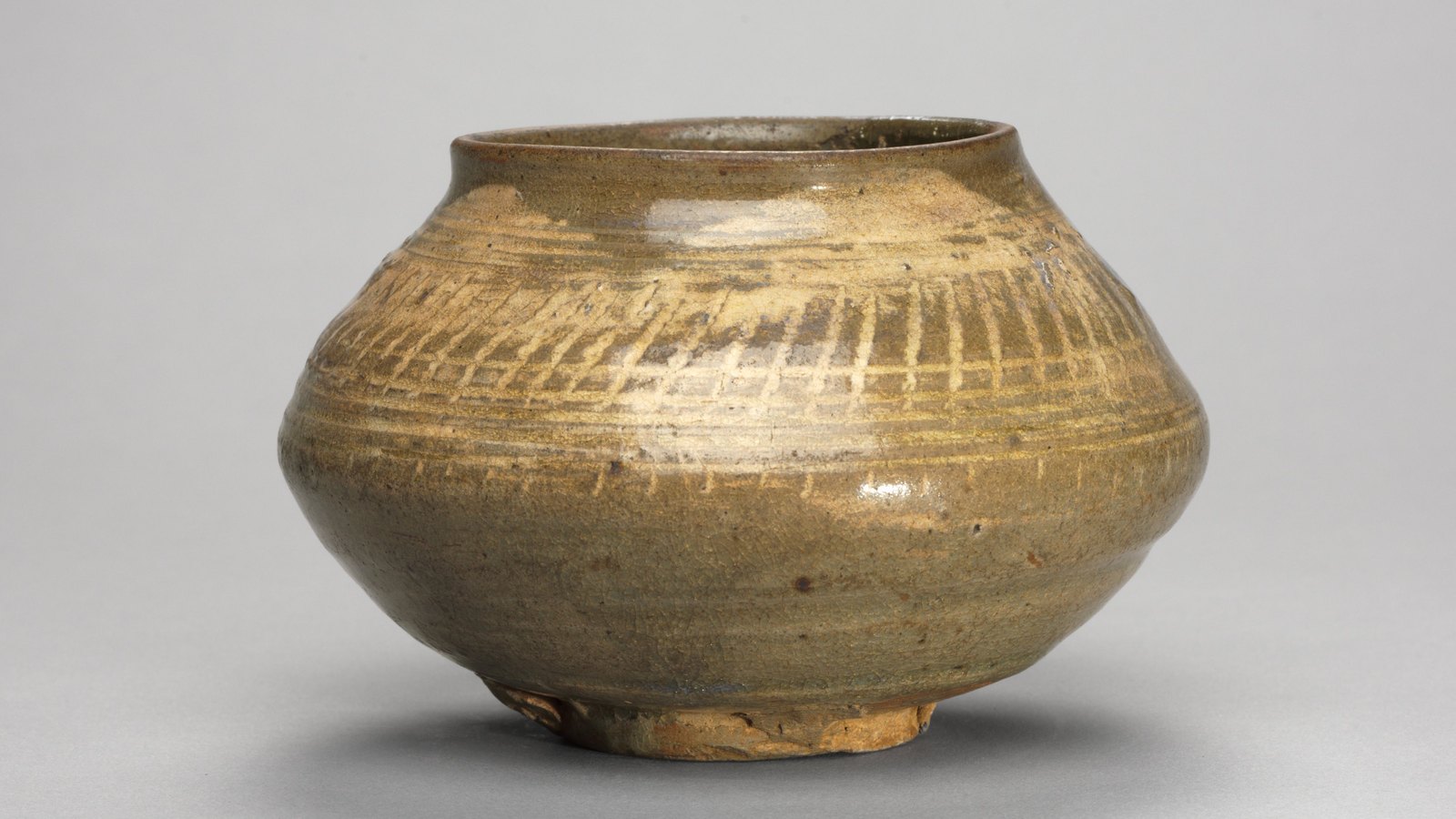
The Cleveland Museum of Art's caddy (1962.498) was made in Korea during the Joseon dynasty, in the seventeenth century. It is a grey-brown stoneware jar with a thin glaze and a band of stamped and incised white-slip decoration across the shoulder. The museum's object text suggests that such jars may have been used by Japanese tea drinkers for powdered tea, and that production may be connected with the Waegwan kilns near Busan.
A related example in the Smithsonian collection, F1901.88a-b, is a low oviform caddy from the Waegwan kilns, covered in white slip and fitted with an ivory lid. Seventeenth-century records mention a trading ship carrying more than 14,000 tea bowls to Japan in a single shipment. The caddy and the bowl travelled into tea practice together: Korean kilns were not only supplying household wares, but taking part in the material world of Japanese tea ceremony.
Material and storage
Ceramic caddies are stable, easy to clean and do not impart a metallic taste. Their weakness is that most are not hermetic. A ceramic lid without a gasket is better for short-term storage than for long ageing. Tin offers better light and moisture protection but costs more; glass lets you see the leaf but must be kept in the dark; a metal tin needs an intact interior coating.
Different teas should not share one caddy without thought. Green tea, light oolong and black tea benefit from small portions, shade and dryness; green tea may be refrigerated, but the caddy should return to room temperature before opening so condensation does not form inside. Pu'er and dark tea change slowly with air and are usually not locked into a completely oxygen-free jar for long periods. A small caddy is fine for a short portion; long-term storage should follow the needs of the tea.
Using one
Wash a new caddy with warm water and let it dry completely; do not soak it in detergent. Check that it has no residual odour before filling. A clean paper liner is acceptable if it is unscented. Close the lid as soon as the leaf is out, and keep the caddy away from heat, sunlight and the refrigerator door. Position matters more than the shape of the jar.